
Thermal Design in Power Electronics
Thermal Design in Power Electronics
From thermal budget and Arrhenius law to active temperature management: DFR methodology and concurrent design in SiC/GaN converters

Executive Summary
Temperature is, without question, the most critical state variable for the reliability of a power electronics converter. Industrial surveys converge on a figure that no engineer should ignore: approximately 55% of premature electronic failures have thermal origin. Behind that percentage is not a single mechanism but a cascade of physical phenomena — thermo-mechanical fatigue from CTE mismatch, accelerated electromigration, dielectric breakdown, creep in bonding materials — all of which accelerate with temperature and, worse still, with its cyclic variation.
The consequence is direct: thermal design cannot be treated as an afterthought. The obsolete practice of closing the schematic and “adding a fan at the end” multiplies the redesign cost between 10 and 100 times. This article translates the fundamentals of modern thermal design into the language of the power converter designer: thermal budget, derating, cooling technology hierarchy, and the transition from “reactive” to “concurrent” design that Premium SA has integrated into its DFR methodology.
1. The Physics Behind the 55% — What Temperature Destroys
1.1 The Arrhenius Law
The most powerful practical rule in thermal design is the Arrhenius law applied to useful life: for every 10 °C increase in Tj, the component failure rate doubles, reducing its useful life roughly by half. Conversely, every 10 °C reduction doubles the life. The mathematical formula is L(T) = L₀ · exp[Ea/k · (1/T − 1/T₀)], where Ea is the activation energy of the degradation mechanism (typically 0.7–1.2 eV in power electronics; 0.94 eV for aluminium electrolytic capacitors per JEDEC).
1.2 Thermo-Mechanical Fatigue — CTE Mismatch as the Dominant Mechanism
If Arrhenius governs degradation at constant temperature, the Coffin-Manson model governs degradation at variable temperature. In any power module, materials with very different CTEs coexist: the silicon chip (≈ 3 ppm/K), the DBC ceramic substrate (Al₂O₃ ≈ 7 ppm/K, AlN ≈ 4.5 ppm/K), the copper metallisation (≈ 17 ppm/K), the SAC305 solder. When temperature rises and falls, each material expands and contracts at its own rate, and the interfaces absorb the mismatch as cumulative plastic deformation. Coffin-Manson establishes that for every 30% increase in ΔTj amplitude, the wire bonds of the module lose a factor of 3 to 5 in cycles to failure.
1.3 Other Temperature-Accelerated Mechanisms
Electromigration — at high current densities and elevated temperatures, electrons drag metal atoms. Dominant model: Black, MTTF ∝ J−2·exp(Ea/kT). TDDB (Time-Dependent Dielectric Breakdown) — traps in the MOSFET gate oxide accumulate until they create a conduction path and catastrophic failure. NBTI/PBTI — hydrogen diffusion in the gate oxide, gradual Vth degradation. Creep — slow plastic deformation in bonding materials of heavy passive components.
Above all these gradual mechanisms is the absolute limit: when Tj exceeds the manufacturer-specified maximum (150 °C for Si, 175–200 °C for SiC, up to 250 °C for some GaN), the device is destroyed instantaneously and irreversibly.
2. The Thermal Budget — The Electrical Analogy
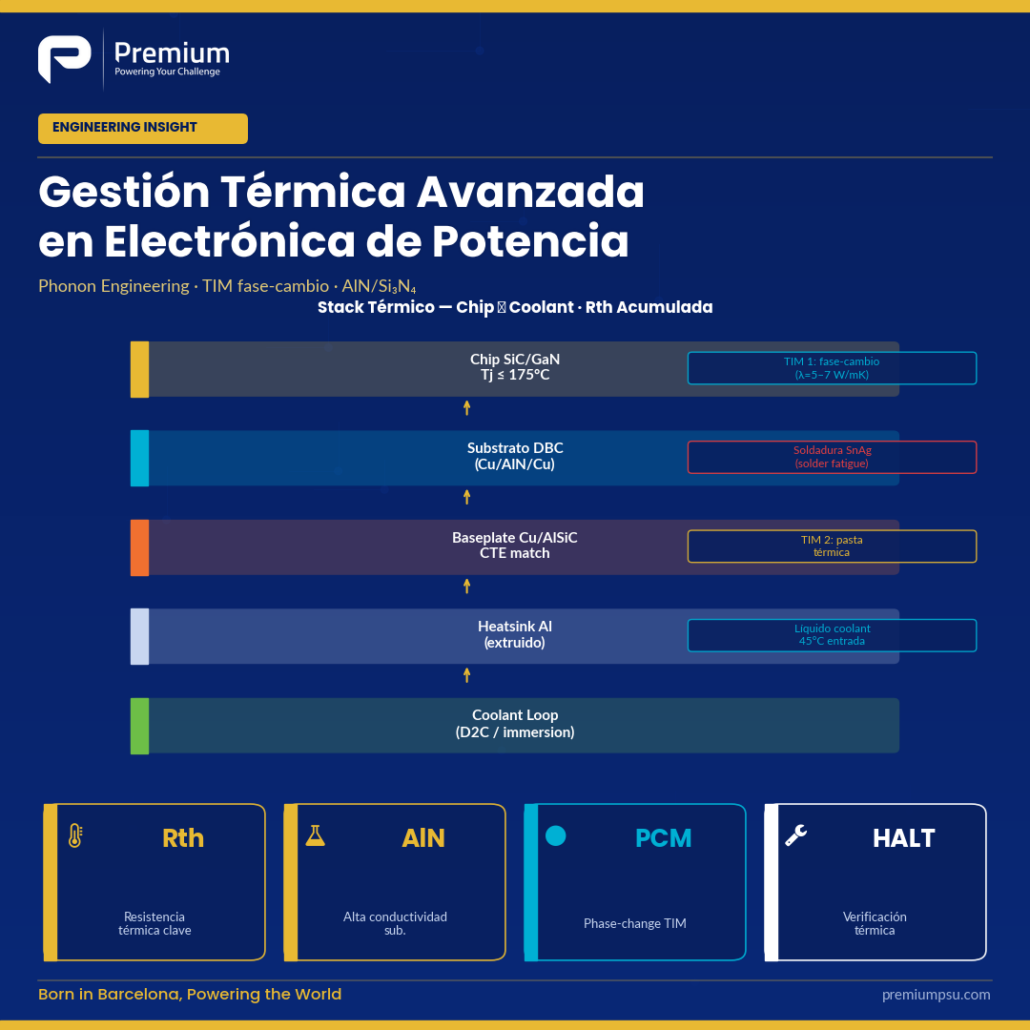
The central analytical instrument of thermal design is the electrical-thermal analogy: temperature → voltage, heat flow → current, thermal resistance → resistance. ΔT = Q · Rth. Junction temperature in steady state is: Tj = Ta + Q · (Rth(j-c) + Rth(c-h) + Rth(h-a)).
2.1 Worked Example — SiC Module in Railway Traction Inverter
2.2 Transient Modelling — Foster / Cauer Networks
The steady-state thermal budget grossly overestimates temperatures under variable load profiles. Transient modelling incorporates thermal capacitance Cth (the material’s capacity to store heat before transmitting it). Foster networks — cascaded Rth-Cth pairs — are the standard format in manufacturer datasheets. The practical consequence: a module can absorb short power peaks without Tj rising to the steady-state prediction value — enabling significantly reduced heatsink sizing in applications with pulsed duty cycles.
3. The Cooling Technology Hierarchy
The golden rule: always use the simplest solution that meets the thermal requirement. Each step up in the cooling hierarchy adds cost, mechanical complexity, and additional failure modes. The selection criterion is set by the surface heat flux density Q/A in W/cm².
| Technology | Max Q/A (W/cm²) | Typical application |
|---|---|---|
| Natural convection | < 0.3 | Low-power, signal electronics |
| Forced air cooling | 0.3 – 2 | Standard rack converters, UPS |
| Liquid cold plate | 2 – 50 | Railway traction inverters, high-power industrial |
| Nucleate boiling | 50 – 200 | High-power prototypes, aerospace |
| Liquid microchannels | 200 – 790+ | AI/OCP servers, future high-density power modules |
3.1 Why SiC/GaN Does Not Relax the Thermal Problem
A frequent — and incorrect — intuition holds that the transition to WBG semiconductors simplifies cooling. SiC and GaN are more efficient, have higher Tj_max, and operate at higher frequencies: three genuine gifts. But the chip is 4–10× smaller than its silicon equivalent for the same current rating, concentrating the heat flux in a much smaller area.
The National Renewable Energy Laboratory has quantified this effect: in simulations of automotive inverters with SiC operating at Tj = 250 °C, DC bus capacitors exceed 130 °C — more than 40 °C above the typical limit of polypropylene capacitors. SiC does not relieve thermal management: it transfers it from the chip to the rest of the inverter.
4. From Reactive to Concurrent Design
The historical reactive approach — close the schematic, lay out the PCB optimising only electrical criteria, and add a fan if temperature rises — carries a well-known structural cost: every thermally-detected problem triggers a redesign cycle whose cost scales as 1× at schematic, 10× at layout and 100× at qualification.
The modern paradigm — integrated into Premium SA’s DFR methodology — is concurrent design. Electrical, mechanical and thermal evolve in parallel, with cross-criteria from the first schematic trace. Component placement in the layout simultaneously obeys three logics: electrical signal integrity, mechanical integrity, and thermal separation between heat sources.
5. Hierarchical Thermal Modelling
| Level | Tool | Time | Use |
|---|---|---|---|
| Level 1 | Analytical models, Rth networks | Minutes | Rule out unviable architectures, compare cooling options |
| Level 2 | Simplified 2D simulation | Hours | Optimise layout, study gradients in critical zones |
| Level 3 | Full 3D CFD, refined mesh | Days | Final design validation before prototype |
| Level 4 | Experimental (IR, thermocouples) | Weeks | Physical prototype validation, model feedback |
The operational rule: never launch a level without exhausting the previous one. Analytical models eliminate 80% of options; 2D refines to 2–3 candidates; CFD validates the final one.
6. The Complete Thermal Chain — TIM, Substrates, Heatsinks
However sophisticated the cooling, heat only evacuates as far as the weakest link in the thermal chain allows. The thermal budget is distributed across all stages, and any of them can become the bottleneck.
6.1 Thermal Interface Materials (TIM)
| TIM | κ (W/m·K) | Premium SA notes |
|---|---|---|
| Standard silicone grease | 1–3 | Outgassing and migration risk in railway cabins with optical sensors |
| Advanced ceramic pads | 6–10 | Current industrial standard |
| PCM metallised pads (phase-change) | >12 | Premium SA standard in railway programmes with silicone restriction |
| Dispersed graphene TIM | ~30 | Next generation — qualification in progress 2026–2027 |
| Gallium-based liquid metals | 50–80 | Al compatibility challenges; high-power prototypes |
| Vertically-aligned CNT | >100 | Research frontier — not yet industrial maturity |
6.2 DBC Ceramic Substrates
| Substrate | κ (W/m·K) | CTE (ppm/K) | Positioning |
|---|---|---|---|
| Al₂O₃ (alumina) | 24–26 | 7.0 | Cost-optimised industrial applications |
| Si₃N₄ (silicon nitride) | 70–90 | ≈ 2.7 | CTE near Si; gaining share in railway with severe thermal cycling |
| AlN (aluminium nitride) | 150–180 | 4.5 | Dominant in railway traction, industrial SiC |
| Diamond DBC | >1,000 | 1.5 | Research / aerospace — cost barrier for industrial |
Si₃N₄ is gaining market share because its CTE (≈ 2.7 ppm/K) is very close to that of silicon (≈ 3 ppm/K), drastically reducing CTE mismatch at the die-substrate solder interface and — via Coffin-Manson — multiplying module life under severe thermal cycling. AlN still dominates for pure κ, but Si₃N₄ is now the preferred choice in railway programmes where thermal cycling fatigue is the dominant failure mechanism.
7. Active Thermal Management — The Lever Available Today
While advanced materials mature, the lever with the best cost/benefit ratio available today is software-based active thermal management (Andresen and Liserre, Microelectronics Reliability, 2014). The controller firmware can significantly reduce ΔTj amplitudes without touching module hardware through four techniques:
(1) Adaptive fsw modulation — reduced during power transients to lower switching losses, with acceptable transient THD increase.
(2) Loss redistribution between parallel phases — the controller identifies the module with the highest Tj (estimated in real time) and shifts current towards less stressed ones.
(3) Real-time Tj estimation — from Vce_sat or RDS(on) measured during switching, reconstructing Tj without additional sensors.
(4) Accumulated cycle counting — firmware tracks power cycles and their associated ΔTj, enabling RUL (Remaining Useful Life) prognosis on wire bonds and solder joints.
8. Synthesis — Thermal Design as a Strategic Decision
Modern thermal design in power electronics rests on five concrete pillars that every Premium SA programme must satisfy:
| Pillar | What it guarantees |
|---|---|
| 1. Thermal budget at schematic | Tj < Tj_design = 0.80 × Tj_max under worst-case mission profile |
| 2. Transient modelling | Realistic heatsink sizing for pulsed duty cycle applications |
| 3. Concurrent design | Layout simultaneously optimised for electrical, mechanical and thermal integrity |
| 4. Optimised TIM–substrate–heatsink chain | No bottleneck at any link in the thermal chain |
| 5. Active thermal management | ΔTj reduction by software → 2–5× life extension with no BOM change |
About Premium PSU
Premium SA is a Barcelona-based specialist in custom power electronic converters for railway, industrial, defence, and energy applications. The DFR (Design for Reliability) methodology integrates thermal design as a fundamental pillar from the conceptual phase of every project. Born in Barcelona, Powering the World.
www.premiumpsu.com · info@premiumpsu.com · +34 932 232 685
Premium SA — Born in Barcelona, Powering the World
Need a custom power supply for your critical application?
Our engineering team designs custom power electronics solutions for railway, defence, energy and industrial applications.