
White paper – From geometry to the watt
Why unit price no longer decides critical power electronics: Physics-of-Failure, the four-gate DFR process, RAMS metrics and PHM behind Premium SA's 40-year reliability commitment.
Railway power electronics: technology vectors, standards and design
Analysis of the rail market and the four technology vectors — SiC, MMC, distributed architectures and bidirectionality — reshaping onboard power electronics, with the EN 50155 regulatory stack and Premium PSU's DFR process. Full portfolio at InnoTrans 2026.

Three-phase resonant converters and planar magnetic integration
Topologies, current-balancing control and 1 MHz planar magnetics: the route to ultra-high power density in DC-DC converters.

Design, calculation and simulation of planar transformers
PREMIUM SA · ENGINEERING INSIGHT · HIGH-FREQUENCY MAGNETICS · 2026 Loss physics, winding structures, parasitics, insulation standards and the open-source software ecosystem for high-frequency magnetics. Executive summary The…

The 800 VDC revolution: the energy engine behind AI
Why the 800 VDC architecture, the sidecar and liquid cooling are turning AI data centers into industrial power plants — figures corrected to source.
White paper – From geometry to the watt
Huawei swaps Moore's geometric scaling for temporal scaling (the τ Law, LogicFolding). But stacking more compute into less volume concentrates power and heat, shifting the performance ceiling from the lithographer to the power engineer. High voltage near the chip, GaN/SiC and power-thermal co-design: the new frontier, and Premium's space.
Industrial Power Converter Selection Guide: 5 Critical Parameters
5 critical parameters most engineers overlook when selecting an industrial power converter — and the most common sizing errors. Practical guide based on 900+ designs manufactured in Barcelona, Spain.
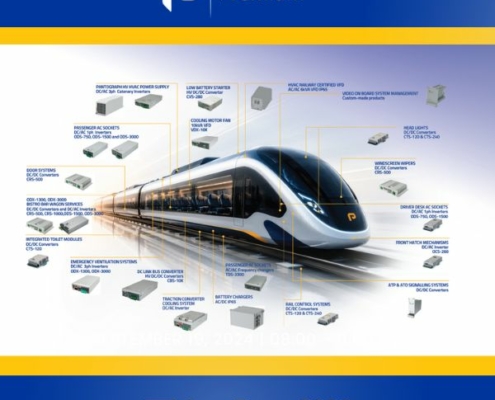
Railway Power Solutions at InnoTrans 2026 | Premium PSU
Visit us at InnoTrans 2026, Hall 17 Stand 425. Our team will be available throughout the four days to discuss railway power solutions, onboard converters and DIN rail systems for demanding environments.
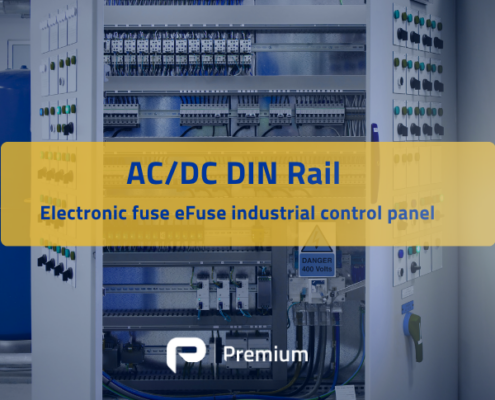
What is an Electronic Fuse (eFuse) and Why Is It Replacing Conventional Fuses in Industrial Panels?
The electronic fuse (eFuse) detects overcurrents in microseconds, interrupts the circuit without blowing, and automatically resets. Unlike a conventional fuse, it indicates which channel has failed via an LED or digital signal, enables selective channel-by-channel protection, and eliminates the need for spare part stock.A solution that becomes more cost-effective than traditional fuses in installations with more than 3–4 faults per year, despite its higher unit cost.