What is it like to work as a Project Manager at Premium PSU?
Behind every power supply there are months of design, testing and technical decisions that must fit the deadlines and demands of the customer. Coordinating multidisciplinary teams, planning projects and responding to complex technical requirements are some of the responsibilities associated with the Project Manager role.
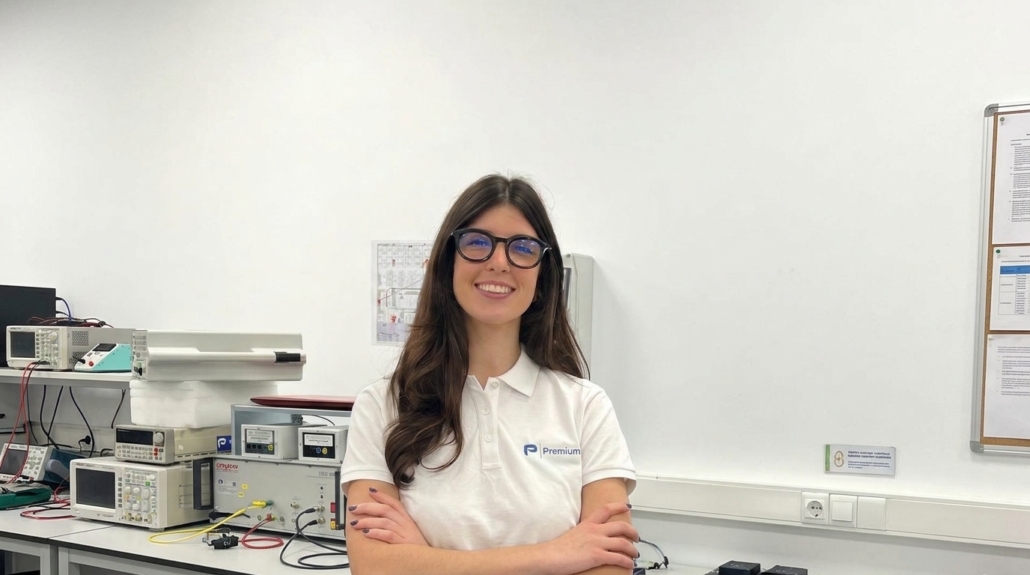
Paula López currently performs that role in the RDI department at Premium PSU. Her path began in design, as a hardware engineer, an experience that gave her a cross-cutting view of our activity, beyond the department itself.
In this interview, she tells us how engineering projects are managed, what challenges the day-to-day work brings, how resources are coordinated and how innovation, quality and compliance with our customers’ technical requirements are balanced.
Meet Paula López, Project Manager in the RDI Department at Premium PSU
What is your job as a Project Manager at Premium PSU like?
My day-to-day work consists of coordinating the issues that arise so that they don’t affect project planning, while continuing to support other departments and our customers.
Every day is different and, for me, that dynamism is one of the best parts of my job. However, what I enjoy most is working hand in hand with my colleagues: planning matters, but so does knowing how the team is doing each day. Ultimately, it is one of the keys to getting the work done.
Your role as a coordinator involves dealing with unusual commercial requests or specifications to keep the project on track, such as an uncommon input range, a tight mechanical envelope or a short deadline, among others. When faced with this kind of non-standard requirement, what is your first technical filter, and how do you turn them into realistic specifications for the engineering department?
My first filter is to sit down with our System Architect to assess whether the requirement fits our experience, and with management to see how we would organise the project.
From the outset, we define which hardware and software engineers will take part and check whether any new standards apply, so that we can coordinate with validation.
Everything is captured in a requirements matrix with the System Architect, which keeps us aligned with the customer and allows us to guide engineering development with clear criteria.
How do you coordinate with R&D&I so that customer deadlines and longer-term development don’t compete for the same resources? Where do you set design reviews and handovers?
We are a multidisciplinary team, and we encourage each engineer to work with different design topologies rather than always specialising in the same one. This way, knowledge circulates, the team learns from one another and we gain flexibility in allocating resources, always in proportion to the scale of each project.
Reviews are based on the V-model: whatever one engineer designs, in both hardware and software, is validated by a different one. That second pair of eyes strengthens the design before each handover.
As part of your work as a Project Manager, we understand that you must bring order to conflicting positions within a project. For example, when the sales team asks to reduce costs or lead times while engineering defends its design margin. How do you resolve this? Which parameters are non-negotiable?
For me, when there is tension between cost, deadline and design margin, the first thing to do is talk to the customer. That way we agree on the state in which we can deliver the prototype, which must always pass the safety tests that guarantee it will work correctly and safely in the final installation.
Another non-negotiable point is that we do not shorten lead times at the expense of quality: we prefer to be transparent with the customer rather than compromise the quality and safety of our products.
Your coordination tasks also include scheduling the use of Premium PSU’s own semi-anechoic room so that designs are electromagnetically compatible. At what stages does a new design go into the room? Have you noticed any change in the pace of the laboratory recently?
Yes, the laboratory has been very busy lately, with innovation projects in new technologies and products for the rail and industrial sectors.
As for when a design goes into the semi-anechoic chamber, basically every time we need to validate it, whether it is the first iteration or the third. To finalise a design and industrialise a piece of equipment, we have to pass all the necessary tests, and we always start in-house before moving on to an external laboratory.
Innovation and talent: the driving force behind Premium PSU
If the conversation with Paula shows anything, it is the importance of coordination, multidisciplinary talent and collaboration between departments in developing advanced power electronics solutions.
At Premium PSU, the ability to tackle complex technical requirements, research new technologies and develop solutions tailored to highly demanding sectors is the result of a constant commitment to innovation, quality and engineering excellence. That is why we foster a dynamic working environment in which our professionals can take on new challenges, expand their knowledge and contribute to the development of the technologies of the future.
Would you like to be part of a team that takes power electronics innovation one step further? Discover our career opportunities and join the Premium PSU team.