
The 800 VDC revolution: the energy engine behind AI
Why the data center has become an industrial energy plant, and how the sidecar, liquid cooling and observability are redrawing the power architecture.

Executive summary
In the AI race, the battlefield has moved to physical hardware: data centers are ceasing to be air-conditioned halls and becoming industrial plants for high-precision energy and heat management. Energy efficiency has stopped being a sustainability goal to become the pillar of financial viability.
The technical trigger is the exhaustion of the 48-54 VDC bus. Above roughly 200 kW per rack, copper and heat impose a physical wall. The ecosystem’s answer —reached at the OCP EMEA Summit 2026 in Barcelona— is the move to 800 VDC with local conversion via «sidecar», mandatory liquid cooling and a new observability layer that turns every converter into a managed node. This article explains the why and the how, with figures corrected to authoritative sources.
Note: the source material’s figures have been adjusted to the official values (NVIDIA: −45 % copper, not 93 %; efficiency up to +5 %; water footprint per queries, not per interaction; 1 point = 1 MW/100 MW). The sources section details the traceability.
Why AI is thirsty for energy
Accelerated computing has changed the rules. Energy and its thermal management have become the dominant share of a modern data center’s operating cost, ahead of hardware and software. And consumption is growing: the International Energy Agency estimates data centers consume around 1.5 % of the world’s electricity today, projected to double by 2030 — the more speculative two-decade projections point to notably larger fractions.
Water is an equally real constraint: available literature places consumption at around 500 ml per 20-50 queries to a language model (not per individual interaction, as is sometimes reported), a figure that becomes decisive at campus scale. And efficiency is measured in money: improving the conversion chain by one percentage point saves on the order of 1 MW per 100 MW installed — at European electricity prices, hundreds of thousands of euros per year per installation. Efficiency is no longer a technical virtue: it is the business model.
The end of the 54 V era: the copper wall
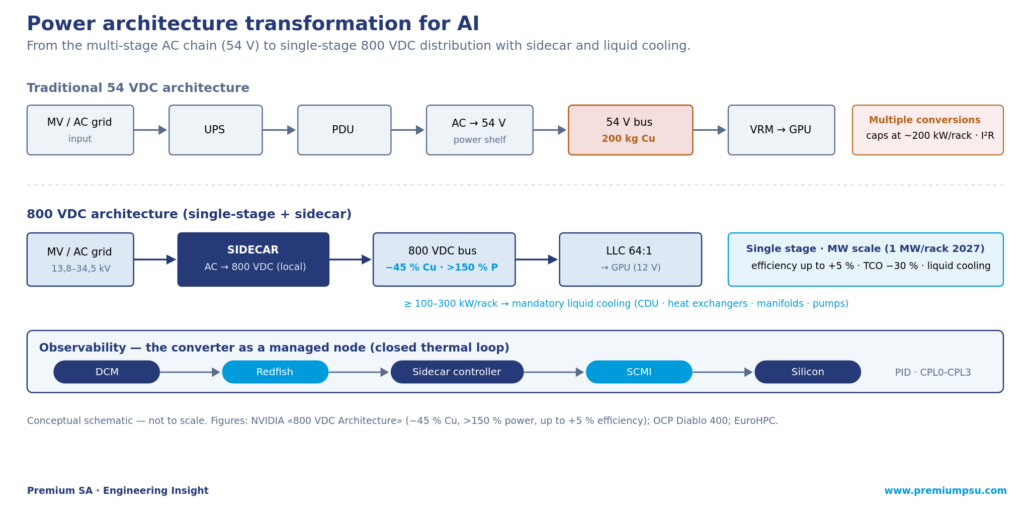
For decades, the 48-54 VDC bus was the gold standard. But powering racks above 200 kW hits a wall of copper and heat: at 54 V, a 1 MW rack would require up to 64U of power hardware alone, with no room for compute. For the power engineer, the leap to 800 VDC is not a new invention but a rediscovery: the same high-voltage-bus and localized-conversion logic that high-speed railway traction has applied since the nineties.
Table 1 — From the 54 V bus to the 800 VDC bus (figures corrected to authoritative source).
| Characteristic | Traditional architecture (54 V) | New architecture (800 VDC) | Source |
|---|---|---|---|
| Power limit | Tops out above ~200 kW | Megawatt-class racks (1 MW from 2027) | NVIDIA |
| Current (600 kW) | ≈ 12,500 A | ≈ 750 A (≈ 16.7× less) | ST / SemiAnalysis |
| Copper mass (1 MW) | ≈ 200 kg of busbar | ≈ 45 % reduction; >150 % power through the same conductor | NVIDIA (official) |
| Efficiency / TCO | Degraded by ohmic (I²R) losses | Up to +5 % end-to-end; TCO −30 % | NVIDIA |
| Technology status | Saturated (copper congestion) | Scalable (electric-traction heritage) | OCP Diablo 400 |
A note of rigour. An inflated figure circulates: that 800 VDC cuts copper by 93 % (from 200 to 13.5 kg). It is incorrect: it confuses the current ratio (≈16.7×) with the real mass reduction. NVIDIA’s official figure is a reduction close to 45 %, with over 150 % power transmitted through the same conductor. Before an engineering customer, a well-supported 45 % weighs more than a 93 % with no source.
The full transformation is summarized in the schematic below: from the multi-stage AC chain to single-stage 800 VDC distribution with sidecar, liquid cooling and closed-loop observability.
The sidecar: the necessary copilot for 800 VDC
The sidecar is a dedicated power rack, adjacent to the compute rack, that receives alternating current from the data center floor and converts it locally to 800 VDC. As Schneider Electric summarized at the OCP EMEA Summit 2026, «the sidecar is the immediate enabler of 800 VDC». It is not an isolated proposal: Oracle has integrated it into its reference designs and Microsoft is deploying it in its new campuses.
For the operator, it offers three strategic advantages: it enables a non-disruptive upgrade, injecting AI densities into existing AC infrastructures without redesigning the whole building’s electrical system; it isolates the fault domain, confining any electrical incident to a single rack and protecting cluster availability; and it leverages the maturity of the electric-vehicle supply chain (650-700 V semiconductors, 400 V-class capacitors and connectors), accelerating qualification and deployment.
Liquid cooling: when air is no longer enough
Concentrating massive power in small spaces has an inevitable consequence: with densities of 100 to 300 kW per rack, fan-based thermal transfer is physically insufficient. The industry is transitioning to liquid cooling, a systemic shift that moves the focus from building air conditioning to chip-level thermal management. The key components of this new era are industrial, not IT:
- CDU (Coolant Distribution Units): the heart of the system; they pump the coolant and separate the primary from the secondary loop, enabling heat to be managed directly at the silicon instead of cooling ambient air.
- Heat exchangers: transfer the thermal energy outward with high efficiency; they are the critical interface for reusing waste heat in industrial networks.
- Manifolds and secondary loops: precision piping that distributes the flow; they require specific materials and control valves to avoid leaks and pressure drops at high density.
- Precision pumps and dielectric fluids: maintain constant flows of glycol water or dielectric oils, guaranteeing long-term reliability with no corrosion or electrical conductivity.
The converter as a managed node: Redfish and SCMI
This physical infrastructure needs a brain to coordinate energy and heat in real time, and it elevates the role of the power converter: it ceases to be a passive component to become an intelligent node that speaks two languages — Redfish, the data center management standard, and SCMI, the communication with the silicon. The telemetry and control flow runs the hierarchy DCM → Redfish → sidecar controller → SCMI → silicon, closing a thermal loop: the system reads the chip temperature and, via a PID controller, adjusts power and flow before throttling occurs.
The critical observability tasks are three: expose the CPL0 to CPL3 capping levels (from sustained operation to the critical limit); execute power-capping (POWERCAP) commands in milliseconds so as not to overload the grid; and provide semiconductor and transformer temperature telemetry with tens-of-milliseconds granularity, feeding the thermal PID. Hardware that does not expose this telemetry precisely is left out of the 30-year service contracts.
2027-2030 roadmap
Table 2 — Transition timeline (aligned with the Premium AI Data Center WhitePaper).
| Phase | Technology milestone | Reference power | Architecture |
|---|---|---|---|
| 2027 | Massive deployment of 800 VDC sidecars | 1.2 MW / rack | High-density hybrid infrastructures |
| 2028-2029 | Room-scale centralized DC distribution | 5 MW | Massive SCMI / Redfish adoption |
| 2030 | Solid-state transformers (SST) | 10 MW | No magnetic transformer; PUE ~1.10 |
Conclusion: Barcelona at the epicentre
This paradigm shift is a unique industrial opportunity. Barcelona —home to the Barcelona Supercomputing Center, designated a node of the EuroHPC AI Factories with an investment close to €198 million— and Microsoft’s multi-campus expansion in Aragón (with PUE 1.12 and zero water) place the region at the epicentre of European sovereign digital infrastructure. This is not a mere technology upgrade, but an ecosystem where high-fidelity power electronics and industrial thermal management are the new sovereigns. In the AI era, efficiency is not an option: it is the business model.
Sources and traceability
Premium SA internal coherence: AI Data Center WhitePaper Premium PSU (Unified) and v2.0; WhitePaper «Railway discipline for AI»; OCP EMEA Barcelona 2026 article; CEO op-ed «Barcelona, the epicentre of the AI energy revolution» (30/04/2026); strategic outlook «Spanish industry in the AI-factory supply chain».
Verified external sources (corrected figures):
- 800 VDC: NVIDIA Technical Blog and «800 VDC Architecture» page (−45 % copper, >150 % power per conductor, up to +5 % efficiency, TCO −30 %, maintenance −70 %, 200 kg/rack at 54 V, 1 MW/rack from 2027); ST Blog and SemiAnalysis (≈12,500 A → ≈750 A); OCP Diablo 400; Schneider Electric quote (OCP EMEA 2026).
- Sustainability: IEA (≈1.5 % of world electricity today, projected to double by 2030); literature on AI water footprint (≈500 ml per 20-50 queries).
- Spanish hub: EuroHPC JU / BSC-CNS (BSC AI Factory, ≈€198 M, MareNostrum 5 upgrade in 2026); Microsoft communication on Aragón (PUE 1.12, zero water).
Editorial note: corrected from the source draft are the copper reduction (93 % → ≈45 %), the water footprint (per interaction → per 20-50 queries), the 1 point = 2 MW → 1 MW per 100 MW relation, and the 85 % OpEx and 7-8 % electricity figures qualified as projections. No published figure contradicts the Premium corpus or the authoritative sources.
About Premium SA
Premium SA is a Barcelona-based manufacturer of electronic power converters for railway, industrial and energy applications. With more than 900 standard product designs and over 40 years of operational experience, Premium SA supplies DC/DC converters, DC/AC inverters, AC/AC frequency converters, battery chargers, rectifiers and UPS systems from 50 W to 72 kW.
As a Barcelona-born industrial company and OCP member, Premium SA brings to the AI ecosystem the 40-year RAMS discipline forged in the most demanding environments —railway traction, substations, defence and energy.