
Premium SA at OCP EMEA Summit 2026 Barcelona: Industrial Discipline for the 800 V DC Era
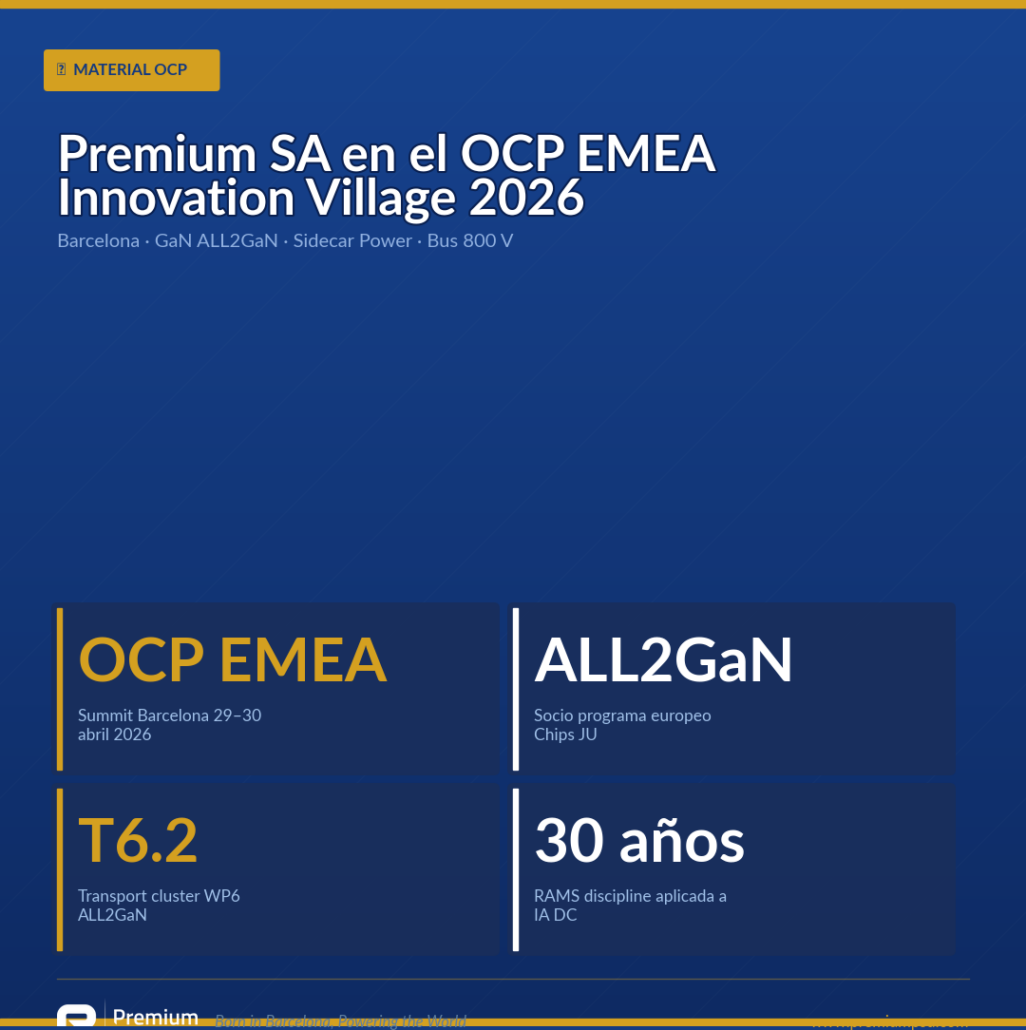
Premium SA at OCP EMEA Summit 2026 Barcelona: Industrial Discipline for the 800 V DC Era
From the open compute ecosystem to industrial power electronics — Why Premium SA engineers are in Barcelona this week and what they bring to the AI rack. Centro Internacional de Convenciones de Barcelona (CCIB) 🔌 High-Density Power for AI & DCs – Booth #A14

Barcelona — Europe’s Power Electronics Capital This Week
The OCP EMEA Summit 2026 takes place on 29–30 April at the International Convention Centre of Barcelona (CCIB), bringing together approximately 1,400 engineers, infrastructure architects, hyperscalers, colocation operators, EPCs and technology providers from across EMEA. Organised by the Open Compute Project Foundation, the event focuses on data centre sustainability, energy efficiency and heat reuse — the three levers that define the economic and regulatory viability of the next generation of compute infrastructure in Europe.
The confirmed agenda features keynotes from AMD, Arm, Broadcom, Google, Intel, Meta, Microsoft, NVIDIA, Rittal and Schneider Electric, dedicated panels on AI cluster scaling and DC power distribution, and a Future Technologies Symposium offering a $10,000 prize for the best paper on 5+ year horizon technologies. Premium SA participates as an OCP member with active presence in the Innovation Village.
The Technical Inflection: From 48 V to 800 V DC
For fifteen years, the server rack lived comfortably within 48 V bus architectures. OCP Open Rack v3 (ORv3) consolidated that standard and allowed the industry to scale deployments to 80–100 kW per rack. The emergence of generative AI has shattered that equilibrium in under three years: a single NVIDIA GB300 NVL72 rack dissipates 125–140 kW, and published roadmaps place next-generation racks between 500 kW and 1 MW.
Physics is unforgiving. Joule resistive losses scale with the square of current (P = I²R), so maintaining low bus voltages at these power levels forces increasingly heavy solid copper busbars. The industry response is to raise distribution voltage: 800 V DC nominal and ±400 V DC bipolar, both covered by the OCP Mt Diablo (Diablo 400) specification co-authored by Meta, Google and Microsoft. The ±400 V choice exploits the supply chain and components consolidated by the electric vehicle industry — power electronics economics meeting mobility economics.
The Invisible Challenge: Transient Power Gaps in AI Racks
Modern computational workloads — especially the synchronous training phases of large models — generate current surges with slew rates that conventional power systems cannot follow. The relevant transients have windows of 1–50 ms, sufficient to cause DC bus voltage dips, GPU compute errors and uncontrolled restarts. The industrial response is a three-tier hierarchical architecture:
| Layer | Time Window | Technology | Key Advantage |
|---|---|---|---|
| Fast | 1–50 ms | Lithium-Ion Capacitors (LIC) / Supercapacitors | Sub-ms response; ~1,000,000 cycles (~200× vs. lead-acid); −50% volume |
| Intermediate | Seconds–minutes | Modular Li-ion Battery Backup Units (BBU) | Grid failure transitions to main UPS |
| Slow | Minutes–hours | Modular grid-interactive HVDC UPS | Peak-shaving, frequency regulation, grid asset |
Direct Current as a First-Class Architecture
The Current/OS Foundation announced in April 2026 a strategic alliance with OCP explicitly targeting the acceleration of natively DC data centre architectures. The core argument: each AC/DC conversion stage introduces typical losses of 2–5% and an additional failure point and control complexity. Eliminating three intermediate stages improves the conversion path efficiency by 5–7 percentage points. For a 100 MW installation running 24/7, a 1% improvement in the conversion chain equals 8.76 GWh/year — between €1–2 million per year at European average electricity prices.
The technology driver is wide-bandgap semiconductors: SiC for the higher-power stages, GaN for the high-frequency bus stages. The 800 V DC → 6 V DC conversion via isolated GaN bus converter achieves peak efficiencies of 97.6% and power densities above 2,000 W/in³. The EMC trade-off: rise times below 5 ns generate significant spectrum up to several GHz, where standard commercial EMC (EN 55032 Class B) is no longer sufficient.
What the OCP Ecosystem Cannot Resolve Alone: Industrial Discipline
Established players in the 1–3 kW/PSU rack compute segment produce millions of units per year in supply chains optimised for hyperscaler economics. Premium SA does not compete — and does not aspire to compete — in that volume segment. The real opportunity lies in the adjacent layers of the HVDC ecosystem where industrial discipline provides differential value that is difficult to replicate:
| AI Data Centre Requirement | Analogous Industrial Sector | Premium SA Asset |
|---|---|---|
| 24/7 uninterrupted operation | Railway traction, substations | Platforms with demonstrated MTBF >10⁶ hours |
| Extreme density and ALARP reliability | Traction converters, industrial drives | Advanced thermal management, conformal coating, IP54 |
| Transient resilience | Industrial microgrids, DC UPS | EPS line with sub-ms response |
| Efficient HVDC conversion | Railway HVDC, grid-scale conversion | Validated topologies up to 72 kW |
| EMC in hostile environments | Railway EN 50121-3-2 | Structurally more demanding standard than EN 55032 |
| Certified critical software | Railway EN 50128 SSIL | V&V above commercial standard |
Premium SA at the Innovation Village — What We Show
Industrial-grade HVDC subsystems for sidecar power racks. Validated 380 → 48 V conversion stages up to 72 kW, scalable HVDC topologies with a specialist partner for front-end above 120 kW, and digital control architecture on a certifiable platform. Immediate application in edge AI deployments, industrial-site micro-data centres and intermediate-generation sidecar racks.
Integrable LIC + BBU modules for transient management. 1–50 ms burst-absorption solution with LIC, seconds-to-minutes backup capability with modular Li-ion BBU, and deterministic control interface on the system supervisor. Roadmap aligned with Diablo 400 / OCP HPR standard.
Industrial auxiliary for CDU, RCU and thermal management. EPS, CLS-120 and TDX-3300 lines already qualified for powering pumps, sensors, variable speed drives and thermal management components of coolant distribution units. A sub-market with CAGR above 20% where industrial thermal and EMC discipline is directly transferable.
Key Figures at a Glance
| Metric | Value | Source |
|---|---|---|
| OCP EMEA Summit 2026 expected attendees | ≈ 1,397 | Vendelux event listing |
| Future Technologies Symposium prize | $10,000 USD | OCP Foundation |
| European DC power electronics market 2024 | €14,000 M | WP Premium PSU v2.0 (2026) |
| European DC power electronics market 2032 | €24,800 M | WP Premium PSU v2.0 (2026) |
| European data centre electrical demand 2030 | 150–168 TWh | WP Premium PSU v2.0 (2026) |
| GaN bus density 800 V → 6 V (TI/Nvidia) | >2,000 W/in³ | WP Premium SA AI DC v1 |
| GaN peak efficiency at 800 V DC bus stage | 97.6% | WP Premium SA AI DC v1 |
| GB300 NVL72 rack dissipation | 125–140 kW | WP Premium PSU v2.0 (2026) |
| LIC service life vs. lead-acid | ≈ 200× | Editorial Roadmap v2 — T16 |
About Premium PSU
Premium SA is a Barcelona-based specialist in custom power electronics for railway, industrial, defence and energy applications. 900+ standard designs, 40+ years operational experience. OCP member and active contributor to the open compute power ecosystem.
www.premiumpsu.com · info@premiumpsu.com · +34 932 232 685 · Born in Barcelona, Powering the World