
What is an Electronic Fuse (eFuse) and Why Is It Replacing Conventional Fuses in Industrial Panels?
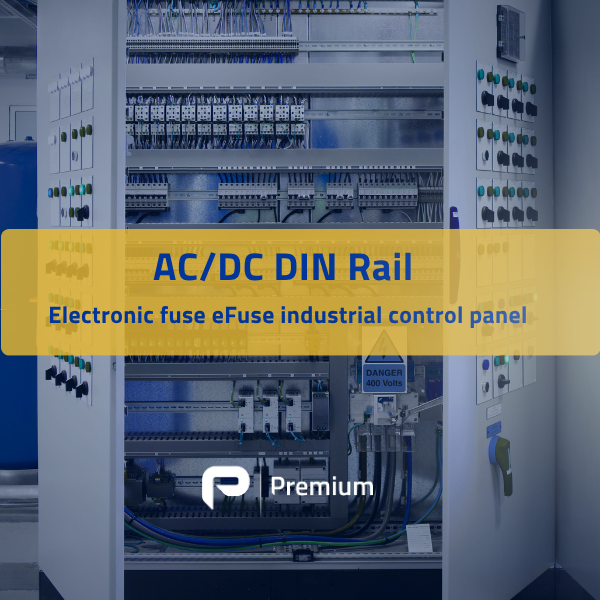
What is an Electronic Fuse (eFuse) and Why Is It Replacing the Conventional Fuse in Industrial Control Panels?
By the Premium PSU technical team · May 2026 · Reading time: 7 minutes
Born in Barcelona, Powering the World
ENGINEERING INSIGHT
What is an electronic fuse (eFuse) and why is it replacing the conventional fuse in industrial control panels?
By the Premium PSU technical team · May 2026 · Reading time: 7 minutes
Keywords: electronic fuse, eFuse, DIN rail, control panel, selective protection, electrical enclosure
Inside any industrial control panel, hidden among terminal blocks and PLCs, there are dozens of conventional fuses. For decades they have served a simple purpose: to blow when the current exceeds the rated limit. Yet that protection model — passive, slow and silent — is becoming obsolete in the face of modern automation system requirements.
The electronic fuse, also known as an eFuse or Electronic Circuit Breaker (ECB), does not blow. It detects overcurrent in microseconds, switches off the circuit electronically, indicates which channel has faulted via LED or digital signal, and can reset automatically once the root cause of the fault has cleared. This article explains how it works, when to apply it, and which parameters to evaluate when selecting the right model.
A counterintuitive technical decision: an eFuse costs between €12 and €25 per protected channel versus €0.50–2.00 for an equivalent conventional fuse. The paradox is that the eFuse proves more cost-effective in any installation that experiences more than 3–4 circuit faults per year. The reasons lie in the real cost of each intervention, not in the price of the component.
- The real problem with conventional fuses
A conventional fuse does exactly what its name implies: it melts to interrupt the circuit. This simplicity carries a cost that rarely appears in the distributor’s catalogue:
- High diagnosis time: when a fuse blows, the operator must identify which of the many fuses in the panel has failed, test each one with a checker or inspect them visually, locate the correct spare in stock, and reinstall it. In a panel with 50 circuits, this process can take 20–60 minutes.
- No indication of root cause: a blown fuse gives no information about whether the fault was a momentary short circuit (electromagnetic noise, inrush current) or a sustained overload pointing to a real load defect. The technician does not know whether to reset or whether there is an underlying fault to repair.
- No automatic selectivity: if the trip current is not properly coordinated with the PSU characteristic curve and the other protective devices, the upstream fuse may blow before the one protecting the faulty branch, causing a wider outage than necessary.
- Spare parts inventory cost: every fuse rating (0.5 A, 1 A, 2 A, 4 A, 6 A, 10 A…) requires stocking spare units. In installations with many different ratings, managing the spares inventory consumes time and money.
The combined effect of these factors makes the conventional fuse a significant source of operational cost in industrial installations with high-density 24 VDC circuits.
- How an electronic fuse works
An eFuse is essentially a controlled electronic switch. Its basic architecture combines three elements:
- Power MOSFET: acts as the switching element. When the controller detects an overcurrent, it turns the MOSFET off in microseconds (typically 10–100 µs), with no electrical arc and no mechanical wear.
- Integrated current sensor: continuously measures the output current of each channel. The measurement is analogue or digital (resistive shunt + ADC) with sufficient resolution to distinguish between a mild overload, a severe overload, and a short circuit.
- Controller with configurable trip logic: compares the measured current against the user-set threshold (via potentiometer, DIP switch, or digital interface) and triggers channel opening when the limit is exceeded, following the desired time curve (instantaneous for short circuits, time-delayed for overloads).
The complete trip sequence — detection, decision, and opening — takes less than 1 ms in most industrial models. A conventional 10 A fuse may take 10–100 ms to blow at 15 A; during that time, a faulty load may have sustained additional damage or propagated the fault to other components.
Comparative trip speed: a short circuit on a 24 VDC circuit protected by a conventional 4 A fuse (type gG) generates a fault current of 20–50 A for 10–40 ms before opening. The same scenario with a correctly sized eFuse is resolved in <1 ms. The difference in energy dissipated in the load is an order of magnitude.
- Operational advantages over conventional fuses
The eFuse’s superiority in industrial applications is not merely theoretical. It manifests across four concrete operational dimensions:
3.1 Instant diagnosis
Each eFuse channel has a status LED (green = OK, red = tripped) and, in models with IO-Link communication or a digital alarm signal, sends real-time status to a PLC or SCADA. The operator — or the supervisory system — knows within seconds which channel has failed without opening the panel. Average diagnosis time drops from 20–60 minutes to 2–5 minutes.
3.2 Reset without physical intervention
Configured in auto-reset mode, the eFuse closes the channel again automatically after a configurable wait time (typically 0.5–10 s). If the fault was transient — an inrush current spike, an electromagnetic interference event — the system recovers on its own. In manual reset mode, the operator presses a button with no need to replace any component.
3.3 Selective protection without complex coordination
The trip current is adjusted channel by channel, with a precision of 0.1–1 A depending on the model. There is no need to calculate coordination curves between cascaded fuses because the eFuse protects only its own channel and does not interfere with the others. A short circuit on channel 3 does not affect channel 4, even if both are powered by the same PSU.
3.4 Elimination of spare parts inventory
A single multichannel eFuse module protects 4 or 8 circuits with different loads. There are no spare fuses to manage, sort, or order urgently in the middle of the night during a plant breakdown. The module has a typical service life of 10+ years with no maintenance.
- Reference figure: Murr Elektronik quantifies in its product documentation (2024) an average 60–80% reduction in fault diagnosis time for 24 VDC circuits when replacing conventional fuses with LED-signalling eFuses. For installations with 50+ circuits, this saving represents between 200 and 600 technician-hours per year in the most demanding cases.
- Applications where the eFuse delivers the greatest value
Not all installations justify the investment in eFuses equally. The applications with the highest return are:
- High-density circuit control panels: automation enclosures with 20 or more 24 VDC circuits powering different loads (sensors, valves, actuators, drives). Density justifies channel-by-channel selective protection.
- Continuous production lines: in manufacturing where every minute of downtime has a direct economic cost (€200–2,000/hour depending on the sector), the eFuse’s automatic reset can restore the system without human intervention and without stopping production.
- Data centres and server rooms: 24 VDC control circuits for IT equipment (PDUs, KVM switches, temperature sensors, UPS systems) demand maximum availability. The eFuse with alarm signal enables integration with Data Centre Infrastructure Management (DCIM) systems.
- Food and beverage OEM machinery: environments with washdown cycles and high humidity where corrosion degrades conventional fuses prematurely. The eFuse, with no mechanical parts, is far more robust in these conditions.
- Solar energy and storage systems: inverters and control systems in photovoltaic installations require protection of auxiliary low-voltage DC circuits (24 V) against faults that could compromise system availability for hours.
- How to choose the right eFuse: five key parameters
Selecting an industrial eFuse requires evaluating five parameters in the order indicated:
- The Premium PSU eFuse range
Premium PSU launches its first range of electronic fuses for DIN rail in 2026, designed specifically for the Spanish and Portuguese markets with local technical support in both languages. The range includes 1- and 4-channel modules for 24 VDC with per-channel adjustable current from 1 to 10 A and a rail width competitive with the best on the market.
Unlike higher-volume manufacturers, Premium PSU combines in a single offer the DIN Rail PSU for power supply and the eFuse for selective protection, with a unified warranty and a single technical-commercial contact for the complete panel. Technical documentation and application diagrams are fully available in Spanish.
- Premium PSU is the only manufacturer simultaneously offering DIN Rail PSU + eFuse with native technical support in Spanish and Portuguese, with field presence in Spain and Portugal. Customers with ongoing projects can request evaluation samples at no charge by contacting their regional sales representative.
The electronic fuse is not an emerging technology; it has been present in the European industrial market for more than a decade and is available in the catalogues of the leading automation manufacturers. What is changing in 2025–2026 is the context: the digitalisation of control panels, the demand for greater production line availability, and the growth of new applications such as data centres and solar energy are transforming the eFuse from an interesting technical option into a standard component in modern projects.
For panel builders and OEMs still designing with conventional fuses, the question is not whether the eFuse is technically superior — it is, in virtually every relevant technical parameter. The question is whether the additional cost per channel is justified in their specific application. The next article in this series answers that question with real figures: a comparative 5-year TCO analysis for an industrial panel with 50 DC 24 V circuits.
Would you like to evaluate whether the eFuse is right for your next project? Contact the Premium PSU technical team: info@premiumpsu.com
PREMIUM PSU · Power supplies equipment and systems · www.premiumpsu.com
| # | Parameter | Typical range | What to evaluate |
|---|---|---|---|
| 1 | Output current per channel | 0.5 A — 20 A | Size to 125% of the load’s rated current. Leave headroom for motor and valve inrush current peaks. |
| 2 | Number of channels | 1 / 2 / 4 / 8 | In high-density panels, prioritise multichannel modules. An 8-channel module occupies 48–80 mm on DIN rail versus 8 individual fuse holders. |
| 3 | Rated input voltage | 24 VDC / 48 VDC | Most eFuses on the market are optimised for 24 VDC. For 48 VDC, verify the model’s input voltage range. |
| 4 | Communication and diagnostics | None / LED / IO-Link / digital signal | For systems without PLC or SCADA: LED is sufficient. For automation integration: IO-Link or digital alarm signal with PLC output. |
| 5 | DIN rail width | 6 – 90 mm / 4 channels | In space-constrained panels, width is decisive. The best models on the market achieve 6–8 mm per channel. |
custom high-reliability power supplies and protection systems for industrial automation,
energy, and critical applications.
Over 40 years of experience in custom power electronics.www.premiumpsu.com ·
Contact our engineering team →
Premium SA — Born in Barcelona, Powering the World
Do you need a DIN Rail power supply or eFuse for your project?
Our applications engineering team responds in under 24 h. No commitment required.